
DryColl DBM
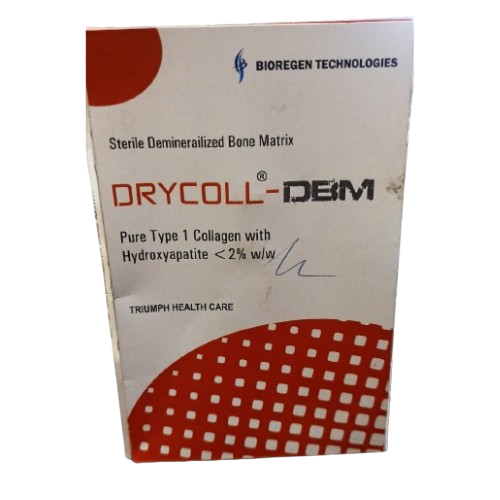
Supplier of DryColl DBM
DryColl DBM is a De-Mineralized Bone Matrix with Hydroxy Apetite. It is designed as a biomimetic bone matrix formulated to closely resemble autologous bone. The matrix possesses both Osteo Conductive and Osteo Inductive properties to support bone regeneration.
Clinical Case Studies & Applications
1. Hip Revision Bone Graft (Proximal Femur Defect Repair)
- Patient Profile: A 65-year-old male presenting 6 years after a hip replacement procedure.
- Diagnosis: Lossening of the femoral prosthesis with CT scans and 3D reconstruction images identifying a proximal bone defect.
- Outcome: Following a hip revision utilizing DryColl DBM bone grafting, radiologic evaluation at 12 months post-op demonstrated successful proximal femoral bone remodeling and a good clinical effect.
2. Bone Graft Fusion between Transverse Processes
- Patient Profile: A 45-year-old female with a 4-year history of low back pain, right lower limb pain, and intermittent claudication.
- Diagnosis: Lumbar spinal stenosis (L4\S4) and lumbar disc herniation (L4/L5) that failed regular conservative treatments.
- Outcome: Post-operative X-ray monitoring tracked progress from 2 weeks (showing autologous and alloy granules) to 6 months. By the 6-month mark, stable bone graft fusion was achieved on the right side with the left side approaching osseous fusion. The patient’s symptoms disappeared completely, allowing a full return to work and daily life.
3. Cervical Interbody Fusion
- Patient Profile: A 42-year-old female with over a 4-year history of cervical spine disease resulting in incomplete paraplegia.
- Procedure: Intervertebral bone graft fusion where DryColl DBM (1.5 cm³) was implanted at C5/6. At the adjacent C6/7 level, a metal intervertebral fusion device was placed, and the accompanying bone graft hole was filled with DryColl DBM.
- Outcome: Post-operative radiographic monitoring (including pre-op, immediate post-op, and 14-week post-op films) demonstrated comparable, successful intervertebral fusion effects at both the C5/6 and C6/7 levels by 14 weeks.
BENEFITS of DryColl DBM
- Biomimetic Composition: Formulated with a de-mineralized bone matrix integrated with hydroxyapatite, creating a structural profile that is closest to a patient’s own autologous bone.
- Dual Healing Mechanisms: Possesses both osteoinductive (signals and encourages new bone formation) and osteoconductive (provides a physical scaffolding for bone growth) properties.
- Rapid Osseous Fusion: Accelerates structural stabilization, with clinical evidence showing stable bone graft fusion starting by week 14 in cervical regions and near-complete osseous fusion within 6 months in lumbar regions.
- Excellent Remodeling & Long-term Outcomes: Facilitates healthy, long-term bone remodeling (proven at 12 months post-op in hip repairs), resulting in complete symptom relief and full restoration of physical function.
SAFETY ADVICE
- Accurate Volume Selection: Ensure appropriate sizing selection based on the specific surgical defect, as the matrix is explicitly dosed and distributed in specific measurements such as 2CC, 5CC, or custom 1.5 cm3
- quantities.
- Radiographic Monitoring Required: Patients must undergo a structured, long-term post-operative radiographic schedule (including X-rays and/or MRIs at intervals like 2 weeks, 6 weeks, 14 weeks, and 12 months) to safely track the progression from early graft bridging to complete osseous fusion.
- Complementary Hardware Verification: When using the matrix to fill hardware (like metal interbody cages or plates), verify secure placement of the primary mechanical implant to prevent graft displacement prior to fusion.